
presented to you by cloud the robot

Brand Guidelines for Small Business: The Perth SME Guide to a Consistent Brand

Have you ever noticed that some businesses just look and feel right, no matter where you encounter them? Their website, their social media, their business cards, even the way they write an email, it all fits together. That is not an accident. It is the result of clear, well-documented brand guidelines.
 
For small businesses across Perth and Western Australia, brand guidelines are one of the most underused tools available. Many business owners assume they are only for big corporations with large marketing teams. The reality is quite the opposite. A solid set of brand guidelines is one of the smartest investments a growing SME can make.


What Are Brand Guidelines, and Why Do They Matter?

Brand guidelines, sometimes called a brand style guide or brand standards document, are a set of rules that define how your business presents itself to the world. They cover everything from your logo and colours to your fonts, tone of voice, and the way you use imagery.
 
Think of them as the instruction manual for your brand. Without one, every piece of content your business produces risks looking and sounding slightly different. Over time, that inconsistency chips away at trust.
 
Consistency builds recognition, and recognition builds trust. Research consistently shows that customers are far more likely to buy from a brand they recognise and feel familiar with. When your brand looks polished and cohesive across every touchpoint, it signals professionalism and reliability, two qualities that matter enormously to buyers in competitive markets like Perth.
 

Why Australian SMEs Are Prioritising Brand Consistency in 2026

There is a noticeable shift happening across Australian small businesses. As digital channels multiply and competition intensifies, more SMEs are recognising that a scattered brand presence is costing them customers.
 
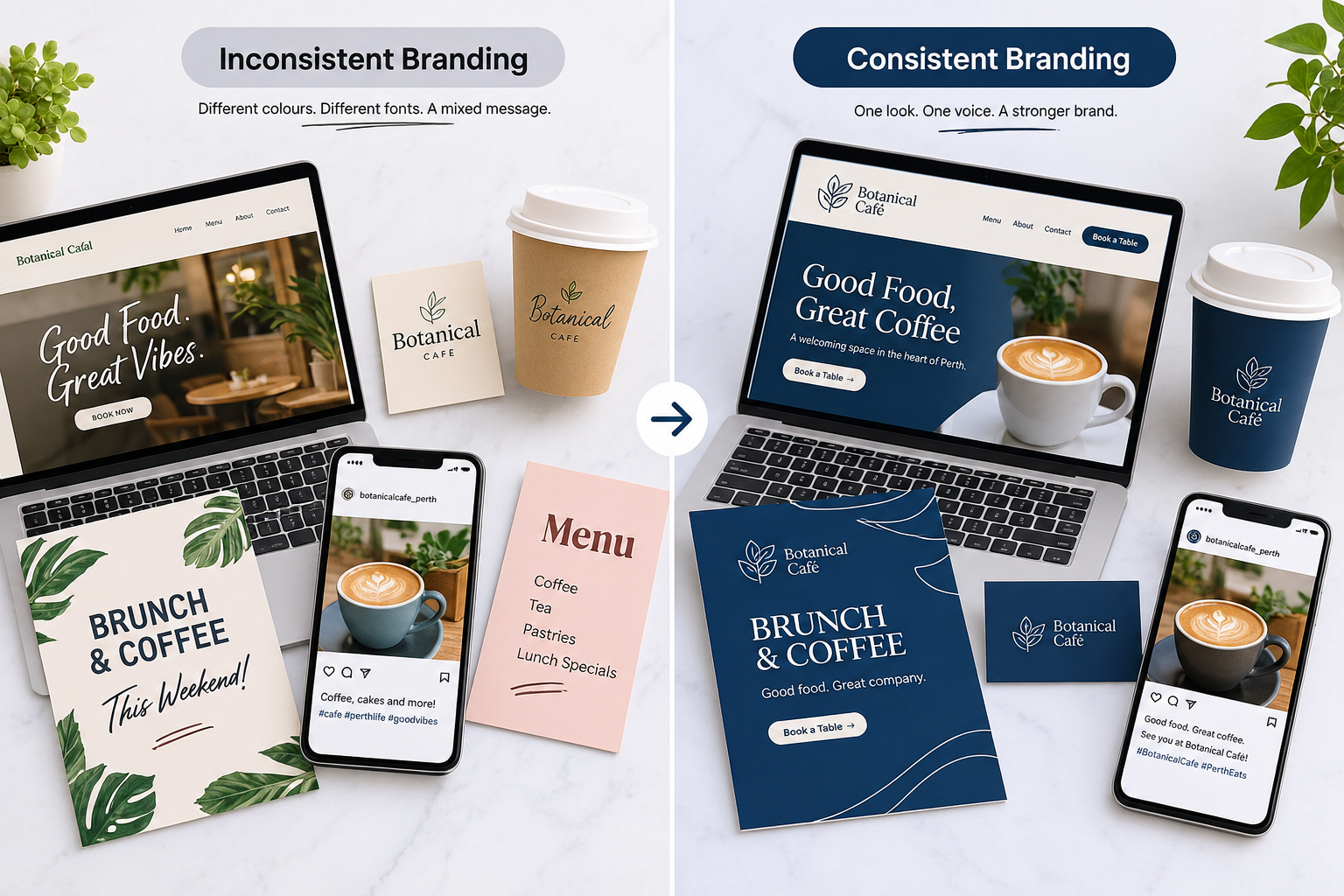
Consider a Perth-based trades business that has a professional logo but uses three different fonts across their website, van signage, and social media. Or a local retail brand that sounds warm and friendly on Instagram but formal and stiff in their email newsletters. These inconsistencies might seem minor, but they create friction. Customers notice, even if they cannot articulate exactly why something feels off.
 
Evidence suggests that businesses with consistent branding across all channels are significantly more likely to be remembered and recommended. In a market where word-of-mouth and online reputation carry enormous weight, that matters.

What Should Your Brand Guidelines Include?

A brand style guide does not need to be a 100-page document. For most small businesses, a clear and practical guide covering the following elements is more than enough to get started.
 

1. Logo Usage

Define how your logo should and should not be used. Include approved versions (full colour, reversed, black and white), minimum sizes, and clear space rules. This prevents your logo from being stretched, recoloured, or placed on clashing backgrounds.
 

2. Colour Palette

Specify your primary and secondary brand colours using exact codes (HEX for digital, CMYK for print). This ensures your brand colours look the same whether they appear on your website, a printed flyer, or a social media graphic.
 

3. Typography

Nominate your brand fonts and explain how they should be used. Which font is for headings? Which is for body copy? Are there approved alternatives for situations where your primary font is not available?
 

4. Tone of Voice

This is often overlooked, but it is just as important as the visual elements. Your tone of voice guidelines should describe how your brand communicates. Is it friendly and casual, or professional and authoritative? Does it use humour? How does it handle complaints or sensitive topics?
 

5. Imagery and Photography Style

Define the type of images that represent your brand. Do you use bright, lifestyle photography or clean, minimal product shots? Are there subjects or styles to avoid? Consistent imagery creates a visual language that customers come to associate with your business.
 

6. Brand Voice in Practice

Include real examples of on-brand and off-brand copy. Show what a social media caption, email subject line, or website headline looks like when it follows your guidelines, and what it looks like when it does not.
 

A Perth Example: Bringing It to Life

Brand guidelines, sometimes called a brand style guide or brand standards document, are a set of rules that define how your business presents itself to the world. They cover everything from your logo and colours to your fonts, tone of voice, and the way you use imagery.
 
Think of them as the instruction manual for your brand. Without one, every piece of content your business produces risks looking and sounding slightly different. Over time, that inconsistency chips away at trust.
 
Consistency builds recognition, and recognition builds trust. Research consistently shows that customers are far more likely to buy from a brand they recognise and feel familiar with. When your brand looks polished and cohesive across every touchpoint, it signals professionalism and reliability, two qualities that matter enormously to buyers in competitive markets like Perth.

How to Get Started With Your Brand Style Guide

Creating brand guidelines does not have to be overwhelming. Here is a practical starting point for Perth SMEs:
 
  • Audit what you already have. Gather all your existing brand assets: logos, fonts, colours, and any marketing materials. Look for inconsistencies.


  • Define your brand personality. Before you document anything visual, get clear on who your brand is. What three words would you want customers to use to describe you?


  • Document your visual elements. Start with logo, colours, and typography. These are the foundations.


  • Write your tone of voice guidelines. Describe how your brand communicates and provide examples.


  • Create a simple, shareable document. A PDF or shared online document works well. The goal is something your team, designers, and suppliers can all access and follow.


  • Review and update regularly. Your brand will evolve. Schedule an annual review to keep your guidelines current.


Common Mistakes to Avoid

Even with the best intentions, small businesses often make a few common missteps when it comes to brand guidelines.
 
  • Making them too complicated. A 60-page document that nobody reads is worse than a simple two-page guide that everyone follows.


  • Forgetting the tone of voice. Visual consistency is important, but verbal consistency is equally powerful.


  • Not sharing them with suppliers. Your brand guidelines are only useful if the people producing your marketing materials have access to them. Share them with your web developer, graphic designer, printer, and social media manager.


  • Treating them as set and forget. Guidelines should evolve as your business grows. Revisit them when you launch new products, enter new markets, or refresh your visual identity.

What This Means for Your Business

Brand guidelines are not a luxury reserved for large corporations. For Perth SMEs competing in a crowded digital landscape, they are a practical tool that saves time, reduces confusion, and builds the kind of consistent brand presence that earns customer trust. Whether you are starting from scratch or looking to bring more structure to an existing brand, the investment in a clear brand style guide pays dividends across every channel and every customer interaction.
 
At Cloud Cartel, we help Perth businesses build brands that are not only visually compelling but strategically consistent. From brand identity design to comprehensive style guides, we make the process straightforward and the results lasting.
 
Ready to build a brand that works as hard as you do? Get in touch with the Cloud Cartel team today.
 

Frequently Ask Questions

What should brand guidelines include?

Brand guidelines should include logo usage, brand colours, typography, tone of voice, imagery and photography style, and examples of how to communicate consistently across marketing channels.

Do small businesses need brand guidelines?

Yes. Brand guidelines help small businesses maintain a consistent brand identity across their website, social media, emails and printed marketing materials. They also help employees and external suppliers follow the same brand standards.
 

How to Get Started With Your Brand Style Guide

Follow these six steps to create practical brand guidelines for your small business:

  1. Audit your existing brand assets. Gather your logos, fonts, colours and marketing materials, then identify any inconsistencies.

  2. Define your brand personality. Choose three words that describe how you want customers to perceive your business.

  3. Document your visual elements. Record your approved logos, colour codes, fonts and rules for using them.

  4. Write your tone of voice guidelines. Explain how your brand communicates with customers and include examples of on-brand messaging.

  5. Create a shareable document. Compile your guidelines into a PDF or online document that your team, designers and suppliers can easily access.

  6. Review and update regularly. Revisit your guidelines as your business grows, introduces new products or updates its brand identity.

Table of Contents

L1 Suite 2/29 Station St, Subiaco WA 6008

Cloud Cartel logo

Websites

eCommerce

Branding

SEO

Google Ads

Social Media

Hosting

Business Support

Printing & Signage

01

Lead
Generation

02

Brand
Visibility

03

Digital
Experiences

04

Creative
Content

05

Online
Discoverability

06

Business
Support

Explore solutions aligned to your business needs.